Nano-Glo® In-Gel Detection System
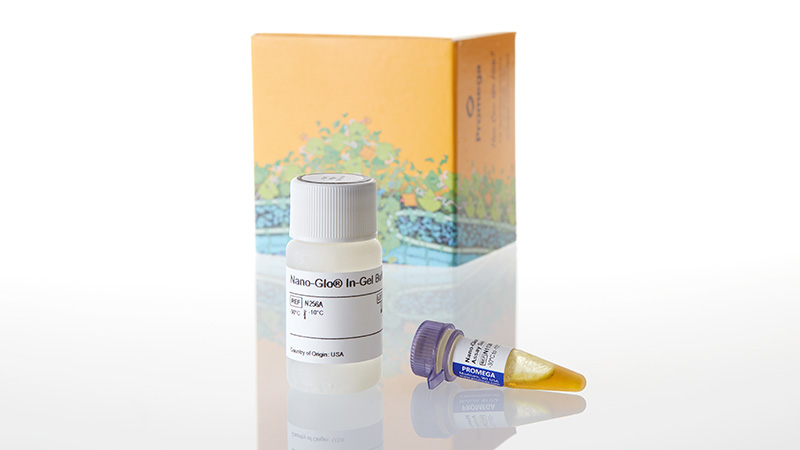
Directly Detect NanoLuc® Fusion Proteins in Polyacrylamide Gels
- Simply incubate native or SDS denaturing gels with reagent and image
- No transfer to membranes required for detection
- Eliminates the need for blocking or antibodies

Catalog Number:
Size
Catalog Number: N3020
Specific and Sensitive Luminescent Detection
Eliminate the need for immunoblotting to detect NanoLuc® fusion proteins separated by polyacrylamide gel electrophoresis. Directly image gels after incubation with the Nano-Glo® In-Gel Detection Reagent. For native PAGE, the gels can be incubated with detection reagent and imaged in less than 15 minutes. For denaturing SDS-PAGE, two washes with 25% isopropanol followed by two washes in water are needed to remove the SDS and allow the NanoLuc® luciferase to refold before detection.
The sensitivity of NanoLuc® luciferase means proteins do not need to be overexpressed to be visualized by the Nano-Glo® In-Gel Detection System.
Easily detect NanoLuc® protein fusions to:
- Verify expression levels
- Confirm correct molecular weight
- Multiplex measurements of multiple luminescent species
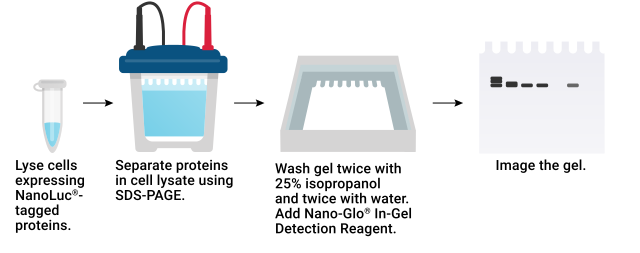
Overview of the Nano-Glo® In-Gel Detection System.
Luminescent Protein Imaging Without Membrane Transfer or Antibodies
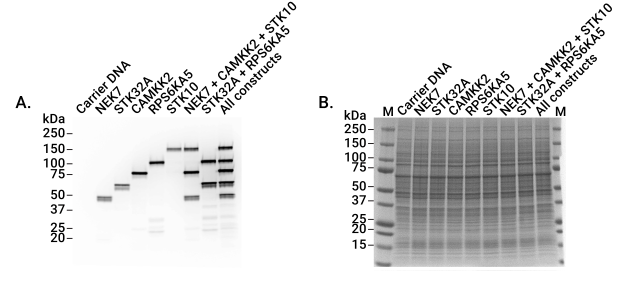
To highlight the ease and specificity in which NanoLuc®-tagged proteins can be detected, HEK293 cells were transiently transfected with CMV expression constructs for five different protein kinases fused to NanoLuc® luciferase. Proteins were expressed in cells both individually and in combinations as shown in the figure to the right.
Cells transfected with carrier DNA alone showed no luminescent background bands, while transfected cells showed fusion proteins of the expected molecular weights. The ability to separate the signals from different NanoLuc® fusions expressed in the same cells highlights the possibility for multiplexing the quantification of multiple proteins (e.g., comparing the levels of a regulated protein and a constitutively expressed control protein).
Protocols
Specifications
Catalog Number:
What's in the box?
| Item | Part # | Size |
|---|---|---|
| Nano-Glo® Luciferase Assay Substrate | N113A | 1 × 200μl |
Nano-Glo® In-Gel Buffer, 10X |
N256A | 1 × 10ml |
SDS
Search for SDSCertificate of Analysis
Use Restrictions
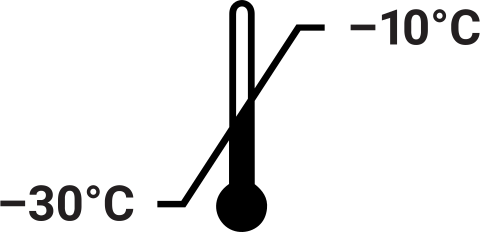
For Research Use Only. Not for Use in Diagnostic Procedures.Storage Conditions
BY USE OF THIS PRODUCT, RESEARCHER AGREES TO BE BOUND BY THE TERMS OF THIS LIMITED USE LABEL LICENSE. If researcher is not willing to accept the terms of this label license, and the product is unused, Promega will accept return of the unused product and provide researcher with a full refund.
Researcher may use this product for research use only; no commercial use is allowed. Commercial use means any and all uses of this product by a party in exchange for consideration, including, but not limited to (1) use in further product manufacture; (2) use in provision of services, information or data; and (3) resale of the product, whether or not such product is resold for use in research. Researcher shall have no right to modify or otherwise create variations of the product. No other use or transfer of this product is authorized without the prior express written consent of Promega.
For uses of Nano-Glo®-branded reagents intended for energy transfer (such as bioluminescence resonance energy transfer) to acceptors other than a genetically encoded autofluorescent protein, researchers must:
(i) use NanoBRET®-branded energy acceptors (e.g., BRET-optimized HaloTag® ligands) for all determinations of energy transfer activity by this product; or
(ii) contact Promega to obtain a license for use of the product for energy transfer assays to energy acceptors not manufactured by Promega.
With respect to any uses outside this label license, including any diagnostic, therapeutic, prophylactic or commercial uses, please contact Promega for supply and licensing information. PROMEGA MAKES NO REPRESENTATIONS OR WARRANTIES OF ANY KIND, EITHER EXPRESSED OR IMPLIED, INCLUDING FOR MERCHANTABILITY OR FITNESS FOR A PARTICULAR PURPOSE, WITH REGARD TO THE PRODUCT. The terms of this label license shall be governed under the laws of the State of Wisconsin, USA.
U.S. Pat. No. 8,809,529, European Pat. No. 2635582, Japanese Pat. No. 5889910 and other patents and patents pending.
Resources
No related resources available
Related Products
Similar Products
Frequently Used With
pNLF1 NanoLuc® Protein Fusion Vectors
Three MCS-based protein fusion vectors that express N- or C-terminal fusions with NanoLuc® luciferase or an N-terminal secreted NanoLuc® reporter.
N1351, N1361, N1371
pFN31 and pFC32 NanoLuc® Protein Fusion Flexi® Vectors
Four protein fusion Flexi® cloning vectors for generating N- or C-terminal fusions of NanoLuc® luciferase with your protein of interest.
N1311, N1321, N1331, N1341
NanoBRET® PPI Starter Systems
Live-cell protein:protein interaction assay. Includes vectors, controls and detection reagent for BRET-based PPI.
N1811, N1821
NanoBRET® Target Engagement HDAC Assays
Directly measure HDAC-test compound affinity and residence time in live cells.
N2080, N2081, N2170, N2090
Promoterless NanoLuc® Reporter Basic Vectors
Two reporter vectors that are used for cloning putative promoter regions to express the NanoLuc® luciferase with different half lives.
N1001, N1011
Promoter-Driven Control Firefly Luciferase Vectors
Three pGL4 reporter vectors with a promoter (SV40, PGK or TK) that are used as the control reporter for dual-luciferase assays.
E6681, E5011, E5061